Author

Follow us



Share this article
Commercial lease incentives are the rent-free periods, rent reductions and fit-out contributions a landlord offers to get you to sign a lease or renew one. At Tenant CS, we negotiate these deals for tenants every week, and the incentive is often where the biggest savings in a lease are won or lost.
Most tenants focus on the headline rent. But the incentive package can be worth a large share of what you'll pay over the term, and landlords rarely put their best offer on the table first.
A commercial lease incentive is a payment or concession a landlord gives a tenant to secure a new lease or a renewal. It's usually expressed as a percentage of the total face rent over the lease term.
For example, a 30% incentive on a lease worth $810,000 in net face rent gives you an incentive pool of $243,000, which you can take as rent-free time, reduced rent, a fit-out contribution or a mix of these.
The three most common types of lease incentive are:
Many deals combine two or more. The right mix depends on whether your business needs cash flow relief, help with set-up costs, or both.
A rent-free period is time during the lease when you don't pay rent. It's usually at the beginning of the lease, though it can be spread across the term, and it's described as "X months rent-free".
Here's a hypothetical example. You negotiate six months rent-free on a five-year office lease with a net face rent of $75,000 a month. That's worth $450,000 (6 × $75,000), or 10% of the total net face rent of $4,500,000 over the term, assuming no rent increases. Your effective rent across the lease becomes $4,050,000.
Rent-free periods suit tenants who need help upfront, for example if you:
Rent-free periods often don't cover outgoings. Check whether you'll still pay your share of outgoings during the rent-free months, as this can make a real difference to your cash flow. You can read more about how commercial lease outgoings work.
A rent abatement is a reduction in rent spread over part or all of the lease term, expressed as a dollar amount or a percentage.
Here's a hypothetical comparison on a five-year lease with a starting net rent of $200,000 a year, increasing by 3.5% a year:
In this example the abatement is worth slightly more in total, but the rent-free option gives you the saving sooner. Which suits you better depends on your cash flow and how you value money now versus later.
A fit-out contribution is where the landlord pays for part or all of your fit-out. Tenants often choose this instead of, or as well as, rent-free time or an abatement when set-up costs are high.
Landlords usually pay fit-out contributions on a reimbursement basis, once you have:
Before you agree, ask whether the landlord will take ownership of any of the fit-out, whether they'll want an incentive guarantee, and how and when payments will be made. If you're planning a new space, our guide to planning a commercial office fit-out covers what to budget for.

A lease incentive is usually calculated as a percentage of the total face rent over the lease term. In its simplest form, that's rent per sqm × area × years.
Here's a worked example. The figures are hypothetical assumptions, not market rates, and the example assumes no annual rent increases:
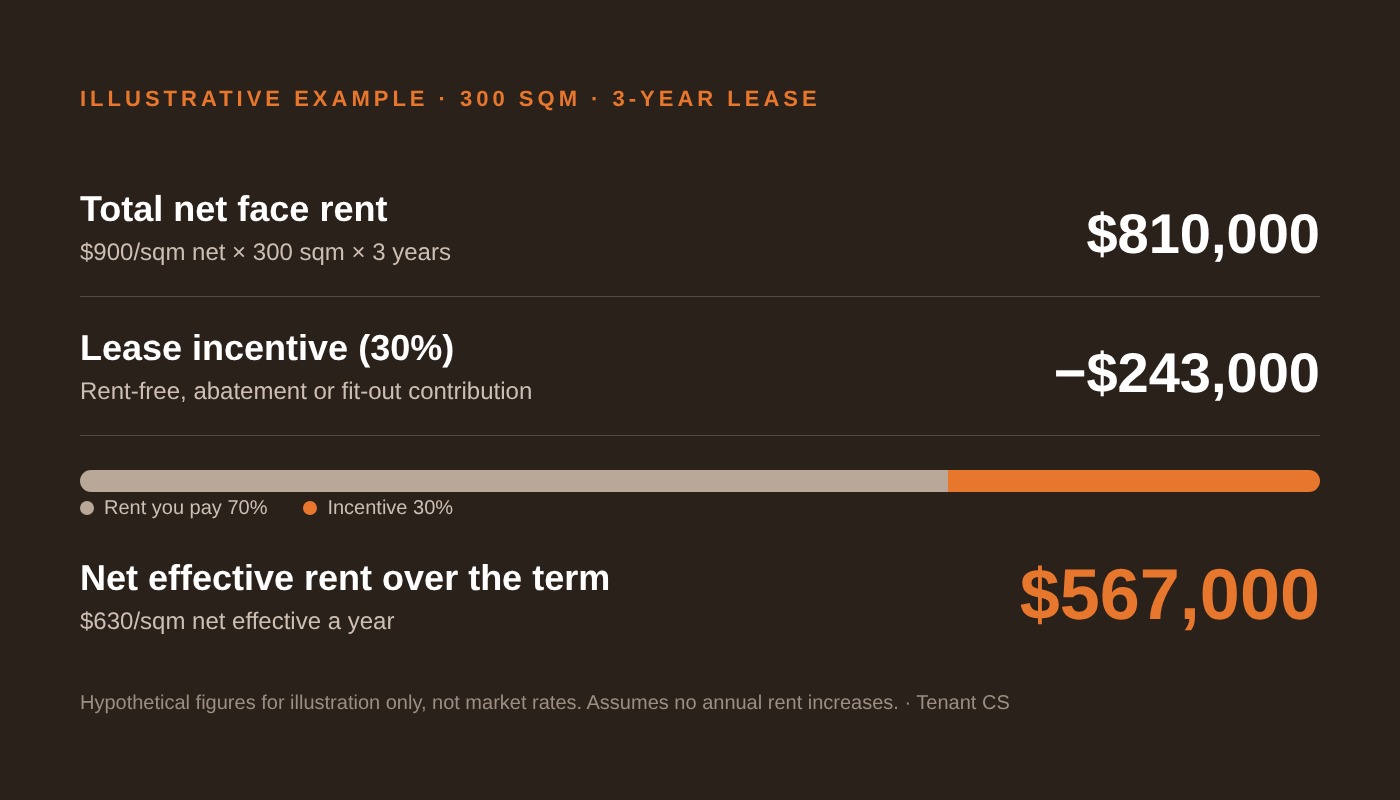
That $243,000 is your incentive pool, which you can then take as rent-free time, an abatement, a fit-out contribution or a combination.
Most leases include annual rent increases, fixed or linked to CPI. In that case the incentive may be calculated on the total rent payable over the term, including the increases, which can result in a larger incentive pool than the simple calculation above. Ask the landlord to show how they've worked out the incentive.
The basis for calculating incentives varies between Australian markets and lease structures:
A 30% incentive on a gross rent is worth more in dollars than 30% on a net rent for the same space. Market reports for different CBDs can also quote rents and incentives on different bases. Before you compare offers, especially across buildings or cities, confirm the basis of each one and convert them to the same footing.
Face rent is the rent written in your lease. Effective rent is what you actually pay once the value of the incentive is spread across the term. In the example above, the net face rent is $900/sqm but the net effective rent is $630/sqm.
Landlords focus on face rent. Tenants should focus on effective rent and, ultimately, the total cost of occupying the space. You can read more about the difference between net, gross, face and effective rent and how face and effective market rent reviews work.
If a landlord is happy to give you $243,000 in incentives, why not just charge less rent? The answer is property value.
Commercial buildings are valued with reference to their rental income, alongside factors such as lease terms, incentives, lease expiry profiles and building quality. Higher face rents can support a building's value and set a higher benchmark for future leasing deals and rent reviews in the building.
That's why many landlords prefer to protect face rents and offer incentives rather than cut the headline rent, and why there's often more room to move on the incentive than on the rent itself.
Tenant tip: Ask for the incentive in the form that suits your business best. Landlords care most about the face rent, so they're often more flexible on how the incentive is structured than on the headline number.

There's no standard incentive. What you can realistically negotiate depends on:
Incentive levels vary widely between cities and building grades and change from quarter to quarter. For current incentive levels in Sydney, Melbourne and Brisbane, see our latest Australian CBD office leasing market report.
The incentive clause matters as much as the number. Before you sign, check:
Decide whether cash flow relief, set-up costs or both matter most. That tells you whether to push for rent-free time, an abatement, a fit-out contribution or a mix.
The incentive a landlord offers depends on vacancy, comparable deals and what nearby buildings are offering. Without that information, it's hard to know whether an offer is generous or well below what's achievable.
Landlords offer more when they know you have real alternatives. Our guide to creating leverage in your lease negotiation explains how. If you're renewing, read why we often advise against simply exercising your option to renew.
Convert every offer to net effective rent over the same term, but don't stop there. Two buildings with the same net effective rent can cost very different amounts once you add outgoings, fit-out costs, relocation costs and make good obligations. Compare the total cost of occupying each space over the term, and when the costs and savings fall, so you can see the real difference in cash flow.
The incentive is one of more than 40 points you can negotiate in a commercial lease. Clawback terms, make good and rent reviews can affect what you actually save. If any of the terms are unfamiliar, our guide to commercial real estate terminology explains them.
Tenant tip: Don't reveal your budget or your preferred building too early. Once a landlord knows you've set your heart on their space, the incentive on offer may shrink.
We only ever act for tenants, never landlords. We track incentive levels, vacancy and comparable deals across the markets we work in, so we know what's achievable before negotiations start.
Book a call with us today to see how we can help you.
A commercial lease incentive is a payment or concession a landlord gives a tenant to secure a new lease or a renewal. Common types are rent-free periods, rent abatements and fit-out contributions. Incentives are usually expressed as a percentage of the total face rent over the lease term, and the size depends on market conditions, building grade, lease length and the tenant's negotiating position.
A rent-free period is a number of months during a commercial lease when the tenant pays no rent, usually at the start of the lease. It's one of the most common lease incentives and helps with cash flow during a move or fit-out. Tenants should check whether they still need to pay outgoings during the rent-free period and whether any clawback applies if the lease ends early.
What a tenant can realistically ask for depends on vacancy in the local market, the building's grade, the lease term, the size of the tenancy and whether it's a new lease or a renewal. Incentives vary widely between cities and change over time, so it's worth checking current market data and comparing offers on effective rent and total occupancy cost before negotiating.