Tenant CS are independent tenant advisors, providing unbiased representation to commercial tenants across Sydney. From renewals and relocations to lease exit strategy, our Sydney team works exclusively for tenants to help businesses make informed property decisions and negotiate stronger lease outcomes.
Talk to our team

.png)





.png)




.png)


.png)


.png)


.png)


.png)


.png)

.png)

.png)
.png)
Most commercial landlords work with a leasing agent to secure the best outcome for their property. Tenant representation puts specialist advice behind your negotiation position.




Sydney CBD remains Australia’s largest and most competitive office market, but headline rents only tell part of the story. Incentives, vacancy, fitout and landlord motivations can all shift the true value of an option. We track the market to show tenants where the strongest opportunities and negotiating leverage sit.
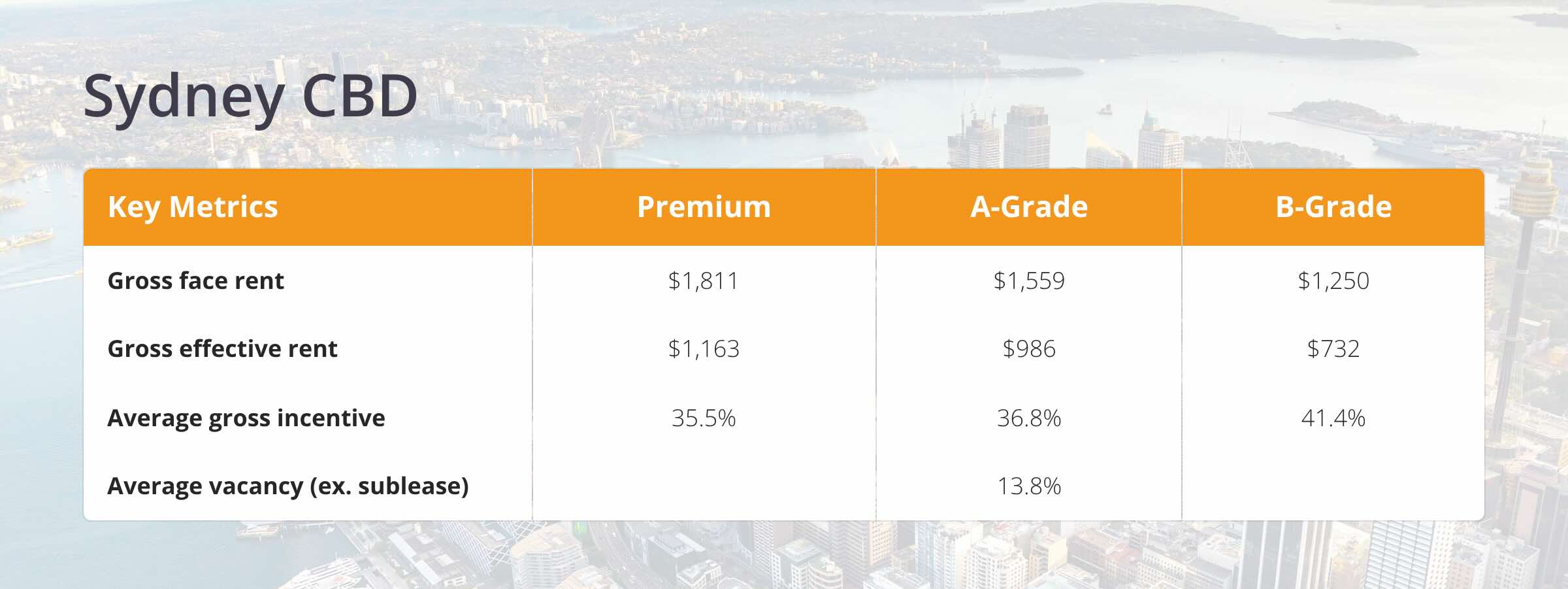
Rents in the Sydney CBD continued to increase in Q2 2026 across all grades, with Premium recording the strongest quarterly and annual growth. Effective rents followed a similar pattern, with Premium increasing to $1,200 (+3.2% QoQ), A-Grade to $993 (+0.7% QoQ) and B-Grade to $735 (+0.4% QoQ). Premium face rents are now 6.6% higher YoY, alongside vacancy tightening from 9.8% to 7.7% over the past 12 months.
Incentives were largely unchanged this quarter, sitting at 35.5% in Premium, 37.0% in A-Grade and 41.4% in B-Grade. The spread between Prime and secondary incentives remains, with B-Grade continuing to transact at materially higher incentive levels.
For tenants, the pricing gap between grades remains significant. Premium rental growth is accelerating as availability tightens, while elevated incentives in B-Grade continue to provide a meaningful offset to headline rents.
.jpg)
Sydney CBD vacancy remained broadly stable at 13.3% in Q2 2026, although vacancy tightened across all three grades over the quarter. Premium vacancy recorded the largest reduction, falling to 7.7%, while A-Grade vacancy declined to 16.0% and B-Grade vacancy declined to 15.8% (although it remains 1.4 percentage points higher YoY).
The tightening in Premium and A-Grade has been supported by positive demand for higher-quality space, alongside limited new supply and withdrawals of existing stock. Availability is particularly constrained within Core Premium buildings, where vacancy is now below 7%, despite overall CBD vacancy remaining elevated.

On the supply side, no new office space is expected to be delivered in 2026, with the next major supply wave concentrated in 2027. 55 Pitt Street (63,000 sqm), Atlassian Central (57,000 sqm) and Chifley South (53,000 sqm) are currently under construction, with these projects collectively more than 60% pre-committed.
With approximately 173,000 sqm of new space due in 2027, vacancy is expected to increase through H2 2027 and into 2028, as both available space within the new developments and backfill from relocating tenants enters the market. Beyond 2027, the development pipeline is limited, with challenging development conditions including construction costs restricting the next wave of new supply.

Sublease availability in the Sydney CBD remains low at approximately 0.7% of total stock, below historical averages. Availability increased only marginally over the first half of 2026, from approximately 35,000 sqm to 37,000 sqm.
Larger availabilities remain concentrated in a relatively small number of buildings, with a recent listing in 200 Barangaroo Ave contributing to available sublease space.
Fitted sublease opportunities remain available, although the overall volume of space remains limited and is not materially adding to broader market vacancy.

The Sydney CBD recorded 18,715 sqm of positive net absorption in H1 2026, with demand heavily weighted towards Premium stock. Premium recorded 19,388 sqm of positive absorption, while A-Grade was broadly flat at 434 sqm and B-Grade recorded -5,418 sqm.
Demand across the Sydney CBD continues to be led by tenants targeting quality space that suits their needs. While Core options in Premium towers remain limited, stronger leasing terms in the Western Corridor are broadening tenant interest outside the Core. The Western Corridor recorded 12,329 sqm of positive net absorption in H1 2026, supporting the trend of tenants seeking a better balance of building quality, amenity and commercial terms.

Some of the recent notable commitments shaping the Sydney CBD market include:
- New Chambers – 126 Phillip St - 1,835 sqm
- BecaPty Ltd – 400 George St - 1,833 sqm
- QUBE Research – 88 Phillip St – 1,830 sqm
- Atmos Group – 333 Kent St – 1,140 sqm (negotiated by Tenant CS)

The longer-term impact of AI on office demand remains uncertain, but in the short term it is unlikely to translate directly into significantly smaller footprints. Growth in AI and technology businesses is creating new roles and new sources of office demand, while other organisations are restructuring teams as automation becomes more embedded.
As Consultant Michael Ly notes, AI is changing the structure of tech teams as much as the technology itself. This does not necessarily mean less space, but it can change the type of space businesses need, from desk numbers and meeting rooms to project areas, training and customer-facing space.
For occupiers, the longer-term impact of AI is therefore likely to be as much about how space is used as how much space is required. As roles and team structures evolve, flexibility within both the workplace and lease will become increasingly important when planning future office requirements.
In H2 2025, demand was concentrated in A-Grade, as tenants pursued quality space at a more competitive price point. In H1 2026, the data shows both flight to quality and flight to value, with Premium recording 19,388 sqm of positive net absorption.
Importantly, quality demand is not confined to the Core. The Western Corridor recorded 12,329 sqm of positive net absorption, close to the Core at 13,491 sqm, as Premium buildings in the precinct provide tenants with access to quality space on more competitive commercial terms.
For occupiers, this means flight to value does not necessarily require a compromise on grade. Premium options outside the Core can offer the balance of building quality and stronger leasing terms that tenants are increasingly seeking.
Tech Central continues to strengthen as Sydney’s major technology and innovation precinct, supporting a $42 billion economy, almost 100,000 jobs and around 4,300 businesses. The precinct already includes major technology occupiers such as Atlassian, Canva, Block, SafetyCulture and Rokt, alongside universities, research institutions and a growing startup ecosystem.
The opening of the Tech Central Innovation Hub at 477 Pitt Street adds around 8,000 sqm of flexible space for startups and scale-ups, while the NSW Government has committed $38.5 million to further develop the precinct. Atlassian Central will provide another major anchor as it approaches completion.
The Tech Central is increasingly becoming a genuine alternative to the traditional CBD Core, particularly for businesses seeking proximity to technology talent, universities, startups and other innovation-led organisations.
Size requirements are beginning to stabilise as hybrid workplace models mature and businesses become clearer on how they want people to use the office. Organisations are testing a range of approaches, from anchor days to activity-based and team-led models – but, importantly, most now have a better handle on typical attendance patterns and space needs than they did two or three years ago. This is consistent with what our team, including Associate Director Courtney Magro, is seeing in recent tenant projects, where requirements are being framed with greater confidence around long-term workplace intent rather than short-term experimentation.
The sharp space give-backs of the immediate post-Covid period have eased, and this is now showing up in the sublease market: availability has fallen back below the 10-year average, indicating fewer tenants are carrying large amounts of excess space. Against this backdrop of more right-sized footprints, elevated construction costs and the highest CBD vacancy in around three decades, fewer landlords are willing to deliver full whole-floor speculative fitouts. Instead, they are focusing on lighter refurbishments or smaller suite-style spec, with layouts and capex more closely aligned to increasingly specific, data-driven tenant briefs.
Sydney’s legal sector continues to favour Premium accommodation, with recent moves into 33 Alfred Street by Allens and Lander & Rogers, and Corrs into Quay Quarter Tower, reinforcing the preference for high-quality, well-located assets. This trend is continuing into the next development cycle, with MinterEllison and Baker McKenzie pre-committing to 55 Pitt Street, and Gilbert + Tobin to Chifley South, both due for completion in 2027.
Our study of 75 mid- and top-tier Sydney law firms found that around 60% had upsized and 39% had downsized, with average tenure in the same building of approximately 7.5 years. The latest pre-commitments appear to be following the same trend, with firms securing larger footprints as part of their next move.
For legal occupiers, these commitments reinforce the importance of getting building quality, location and flexibility right from the outset, particularly when leasing decisions can shape workplace requirements for much of the next decade.
Sustainability remains a core filter for office occupiers, particularly larger corporates with formal decarbonisation targets. For many local and offshore tenants, strong ESG credentials are increasingly treated as a baseline requirement rather than a “nice to have”.
Tenants continue to favour buildings with strong Green Star, NABERS and/or WELL ratings. At the same time, recent analysis indicates only around 28% of Australian office buildings are on track to meet major tenants’ climate needs.
This is narrowing the pool of suitable accommodation and increasing the divide between newer or comprehensively refurbished assets and older stock.
The future Atlassian HQ at Tech Central (due 2027) illustrates where demand is heading: a low-carbon, hybrid-timber, fully electric building targeting leading sustainability ratings. For tech and innovation-led occupiers, assets of this type align leasing decisions with climate commitments and employee expectations, while reducing exposure to future regulatory and carbon-cost risk.
True tenant representation gives you access to independent advice, better market insight, and a stronger negotiating position, helping you make the most informed property decisions.






Meet the team representing commercial tenants across Sydney CBD and surrounding office markets.

"Professional, efficient, and tenacious, Tenant CS negotiated a great outcome for us – securing outstanding terms at our new premises while reducing our makegood liability at our previous space. I am incredibly appreciative of their counsel and support throughout this entire process. Highly recommended."
.png)
"Thanks for all your help! You have helped us enormously to unravel the quagmire of CBD leasing!"
.png)
"The team went above and beyond to protect our interests, fighting in our corner and securing a fantastic outcome. We are incredibly grateful to have had them by our side every step of the way and couldn't be happier with the result. Thank you!"
.png)
“Thanks to Tenant CS’ professional approach and flexible fee structure we never missed a rent review, lease expiry date or beckoning market opportunity. Better yet, we were able to generate significant savings.”

“In preparation for an inspiring “return to office”, we were looking for a space that our staff would love to spend time in. Tenant CS delivered in droves, securing an iconic wool store in the city fringe - a competitive market withlimited options. Even better? They negotiated favourable terms and brought professionalism and attention to detail along the way.”
.png)
“Tenant CS carried out a Stay vs. Leave analysis for our Melbourne and Sydney offices. The service was beyond our expectations. The team ran the project professionally and with entrepreneurial flair.”

“I am excited about our new office and the benefits the improved working environment bring to NBCF. Engaging Tenant CS meant that we truly unlockedthe added value of using a tenant representative, and I highly recommend theteam to anyone looking for real estate advice.”

Whether you're approaching a lease expiry, considering a relocation or simply want to understand what the Sydney market could offer, speak with our tenant representatives before making your next property decision.



.svg)