
Tenant CS works exclusively for your business, never landlords. Representing commercial tenants across Melbourne, our independent advice combines Melbourne market intelligence and commercial negotiation expertise to help you secure the right premises, tenant-friendly terms and reduced occupancy costs.
Talk to our team
.jpg)
.png)


.png)
.png)
.png)
.png)

.png)
.png)

.png)





.png)


.png)

.png)
.png)
Landlords enter lease negotiations with professional advisors, market information and a clear commercial strategy. Our independent tenant representation gives your business the expertise and evidence needed to negotiate on equal footing.




Current market evidence helps tenants benchmark rents, assess incentives and negotiate from an informed position.
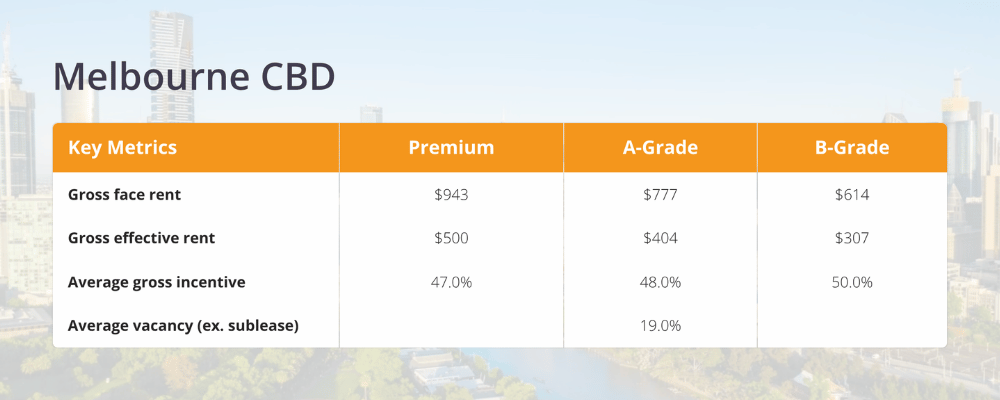
Net face rents increased across most grades during Q2 2026. Premium-grade face rents rose 1.4% to $956, A-grade remained unchanged at $777, and B-grade increased 1.6% to $624.
Incentives eased across all grades during the quarter, declining 0.7 percentage points for Premium to 46.3%, 0.1 percentage points for A-grade to 47.9%, and 0.8 percentage points for B-grade to 49.2%. Despite the reduction, incentives remain elevated across the market.
Reflecting the movement in face rents and incentives, net effective rents increased across all grades, rising 1.2% for Premium to $506, 0.2% for A-grade to $405, and 1.6% for B-grade to $312.
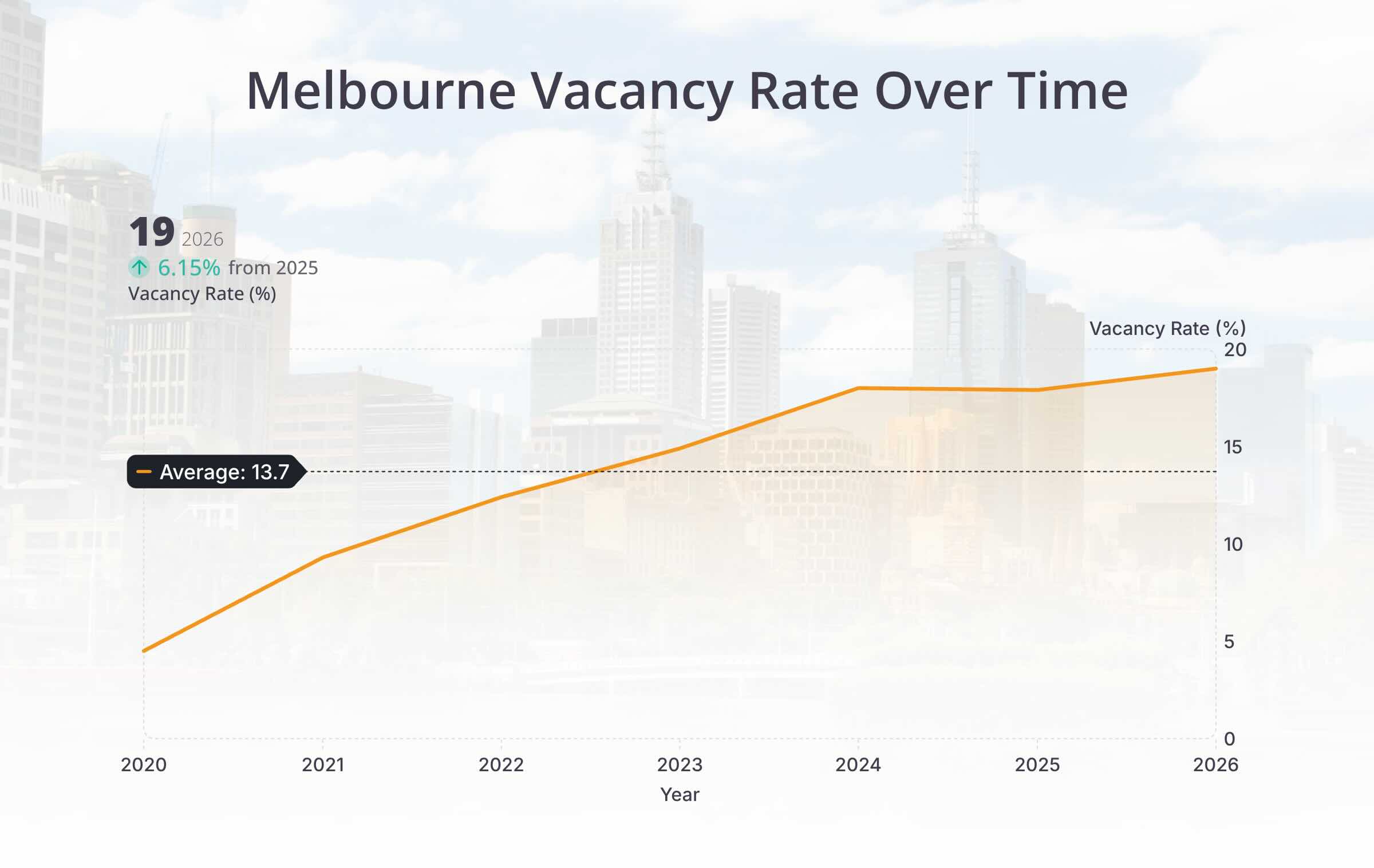
Melbourne CBD vacancy remained elevated at 18.9% in July 2026, marginally down from 19.0% in January. Based on total stock of approximately 5.28 million sqm, this represents close to one million sqm of vacant office space. Net absorption improved to approximately 29,500 sqm in H1 2026, driven by positive Prime demand, following several years of weak or negative absorption.
.jpg)
Melbourne has experienced periods of substantial new supply since 2020, coinciding with weaker tenant demand and rising vacancy. While the development pipeline is now moderating, further supply remains, including 435 Bourke Street, with approximately 60,000 sqm expected in 2026. New development is relatively limited thereafter until the next major wave of projects expected from 2031–32.
Near-term vacancy pressures are expected to persist. The Victorian Government recently announced plans to offload space across 121 Exhibition Street, 8 Nicholson Street and 50 Franklin Street, contributing to approximately 100,000 sqm of government backfill expected across the CBD. This will add to an already substantial pool of available space and place further pressure on vacancy despite the slowdown in new construction.
We expect Melbourne CBD vacancy has not yet peaked, with further backfill and historically weak tenant demand likely to place upward pressure on vacancy through to 2028. Thereafter, stock withdrawals and limited new construction may support a gradual recovery, although this will remain dependent on tenant demand and the absorption of existing vacant space before the next development cycle begins from around 2031.
.jpg)
Melbourne CBD sublease vacancy declined materially during H1 2026, from approximately 64,000 sqm in January to 45,000 sqm in July, equivalent to around 0.9% of total stock. Availability is now below the historical average. Although Melbourne continues to record the highest volume of sublease space among the major Australian CBD markets.
Sublease space remains an attractive alternative to direct leasing, typically offering discounted effective rents, existing fitouts and shorter lease terms. This continues to provide cost savings and flexibility, particularly for tenants seeking near-term solutions or project space.
.jpg)
Melbourne CBD demand improved through H1 2026, with total net absorption of approximately +29,500 sqm, following several years of weak or negative demand. By grade, demand was heavily concentrated in A-Grade, which recorded +53,460 sqm of net absorption. Premium (-14,983 sqm), B-Grade (-4,990 sqm) and C-Grade (-6,913 sqm) all recorded negative absorption.
At a precinct level, the Eastern Core (+18,911 sqm) and Flagstaff (+15,455 sqm) recorded the strongest net absorption, while the Western Core (-10,634 sqm) was the weakest performing precinct. Docklands recorded modest positive absorption of approximately +1,500 sqm.
The concentration of demand within A-Grade highlights the continued preference for quality accommodation, while negative absorption across Premium and secondary grades demonstrates that demand remains uneven across the market.
.jpg)
Some of the commitments which will shape the future of the Melbourne CBD include:
- APA Group – 161 Collins Street (Civic) – 4,000 sqm
- FM Global – 51 Flinders Lane (Eastern Core) – 1,900 sqm
- AirTrunk – 51 Flinders Lane (Eastern Core) – 1,900 sqm
- GB Energy – 90 Collins Street (Eastern Core) – 1,139 sqm
.jpg)
Landlords are increasing investment in third-space amenity across Melbourne CBD buildings in response to growing demand from tenants and employers for greater functionality outside the traditional tenancy. Larger shared boardrooms are increasingly being replaced by smaller meeting rooms offered on a pay-per-use or first-come, first-served basis, giving tenants access to additional meeting capacity without carrying that space within their permanent footprint.
Demand is also broadening beyond meeting and collaboration spaces toward wellness-focused amenity. Mini gyms, recovery areas and purpose-built rooms for rest, faith, parents and first aid are becoming more common, alongside continued investment in end-of-trip facilities including bike storage, showers and EV charging.
For tenants, these facilities can reduce the need to replicate certain functions within their own tenancy while supporting employee experience and workplace attendance. As employers place greater emphasis on attracting staff into the office, the quality and functionality of third-space amenity is becoming a more important consideration when comparing buildings.
The Victorian Government’s proposed work-from-home legislation remains a key uncertainty for Melbourne’s office market. The Bill, which would provide eligible employees with a right to work from home two days per week where reasonable, has passed the Legislative Assembly but remains before the Legislative Council. Following a change in Premier, implementation has been delayed from September 2026 to July 2027 to allow further consultation with the business community. The Government has indicated it still intends to pass the legislation before the November 2026 state election.
The timing remains significant for Melbourne, where CBD vacancy sits at 18.9% and office attendance continues to influence occupier space requirements. This is particularly relevant given the Victorian Government’s own consolidation of its CBD footprint, which is expected to contribute approximately 100,000 sqm of backfill across the market.
The legislation may have longer-term implications for workplace utilisation and future space requirements. As leases approach expiry, businesses are increasingly assessing their footprint against actual office attendance, and a legislated right to work from home could further influence these decisions. This may contribute to continued consolidation and reduced space requirements, adding further backfill to a market already carrying elevated vacancy.
As noted by Jared Kroeger, a renewed shift toward A-Grade buildings is starting to emerge across the Melbourne CBD, particularly in assets that offer stronger workplace amenity and a more considered occupier experience.
“Tenants are still cost-conscious, but many are now looking more closely at how a building supports staff experience day-to-day. Buildings with strong amenity (whether that’s third spaces, upgraded lift lobbies, or end-of-trip facilities) are standing out. It’s less about a traditional flight-to-quality, and more about being selective. Tenants are willing to move up the quality curve, but only where the value is clear.”
H1 2026 leasing data supports this trend, with 53,460 sqm of positive net absorption, while Premium (-14,983 sqm), B-Grade (-4,990 sqm) and C-Grade (-6,913 sqm) all recorded negative absorption.
This demand is occurring against significant existing availability. At the beginning of the year, A-Grade vacancy stood at 20.6%, representing approximately 546,000 sqm, while Prime stock accounted for almost three quarters of all vacant space across the CBD. The depth of available A-Grade accommodation has created strong competition between landlords, providing tenants with access to higher-quality buildings, strong incentives and increasingly competitive fitted options.
The combination of significant availability and competitive terms is allowing tenants to achieve better value for their occupancy cost, with higher-quality accommodation becoming increasingly attractive relative to lower-grade alternatives. The strong H1 absorption indicates tenants are taking advantage of these conditions, although A-Grade remains a highly competitive market for landlords rather than a constrainedmarket for tenants.
From 1 January 2026, the Melbourne congestion levy on off-street parking rose sharply, with Category 1 (CBD) rising from $1,750 to $3,030 per bay per year and Category 2 increasing from $1,240 to $2,150. The Category 2 area has also expanded into Burnley, Cremorne, South Yarra, Windsor and parts of Richmond, Abbotsford and Prahran, while the Queen Victoria Market area moved to the lower Category 2 rate.
For tenants with significant parking requirements, the increase can materially affect total occupancy costs where the levy is passed through via parking charges or other property costs. The expansion is particularly relevant when comparing CBD and fringe locations, as several inner-eastern precincts that previously sat outside the levy are now subject to the Category 2 rate. Parking requirements and associated costs should therefore be considered alongside rent, incentives, transport access and staff catchments when assessing future leasing options.
Fitted space continues to lease ahead of vacant space, with a clear hierarchy emerging in the sub-300 sqm market. Well-designed, modern spec suites are leasing faster than older or more generic fitouts, as smaller tenants prioritise quality, convenience and avoiding upfront fitout costs.
Older spec suites are still leasing, but typically require stronger incentives or landlord contributions towards refresh works to compete with newer, better-presented options. For tenants, the depth of fitted options provides an opportunity to compare not only rental terms, but the quality and usability of the existing fitout and the overall cost of occupation.
ESG credentials remain an important consideration for Melbourne tenants, particularly larger corporates with sustainability targets and reporting requirements. Buildings with strong NABERS ratings, modern services, and better staff amenity continue to attract interest, particularly across Premium and A-Grade stock, where demand has improved materially over the past six months.
The significant availability of A-Grade space is providing tenants with greater access to buildings with stronger ESG credentials without necessarily moving to the Premium end of the market. This aligns with the broader shift toward A-Grade in H1 2026, which recorded +53,460 sqm of net absorption while B-Grade demand remained negative.
For tenants, ESG is increasingly considered alongside building quality, amenity and overall value rather than in isolation. The depth of available A-Grade stock means tenants can be more selective and incorporate sustainability requirements into a broader assessment of workplace quality and occupancy cost.
The value of a tenant representative goes beyond finding space. We give your business the latest industry information, stronger negotiating leverage and greater control over your property moves.






Local market knowledge and commercial negotiation expertise, backed by one national team.

“Partnering with Tenant CS was, quite simply, an exceptional experience. They intuitively understood what we needed and worked tirelessly to not only find the perfect space for us, but also during negotiations to ensure it was the right space at the right price. The processes, strategic guidance and expertise that Jared and team provided was second to none and elevated the entire experience.”
.png)
"Next time you’re at the MCG, in front of a full stadium, have a look at 1/4 of the stands… 25,500 people… that’s how many additional phone calls - calls for help - we can answer because of the real estate savings Tenant CS has made for us."
.png)
"Professional, efficient, and tenacious, Tenant CS negotiated a great outcome for us – securing outstanding terms at our new premises while reducing our makegood liability at our previous space. I am incredibly appreciative of their counsel and support throughout this entire process. Highly recommended."
.png)
Whether you are renewing, relocating or reviewing your options, our Melbourne tenant representatives can help you understand the market, compare the alternatives and negotiate from a stronger position.




.svg)